Temporary works are the hidden supports — props, shores, needles, formwork — that hold your home up while a wall comes out, a beam goes in, or a basement is dug. Skip it or bodge it and you’re looking at cracks, movement, or worst case a collapse the insurer won’t cover.
That’s where a Structural Engineer Near Me comes in.
Let’s keep it simple and useful.
A Structural Engineer West London takes your planned build and works out — mathematically — exactly what has to hold the building up while the permanent works happen.
That package is what stands between a clean build and a wall cracking, a floor sagging or the neighbour’s house starting to move.
Call 0207 101 3687 and receive a no obligations quotation
We’ll arrange a visit that suits you, walk the property, measure openings and loads, and gather everything the temporary works design needs.
After the inspection, we’ll run the calculations, produce drawings and sequence sheets for the build and Building Control approval.
Throughout the project, you’ll always be able to reach us for any assistance — whether it’s builder queries, site changes or Building Control.
This is where most homeowners get confused — so let’s break it down clearly. A temporary works design often begins with, or follows on from, our structural surveys and reports service — particularly when the existing walls, floors or foundations need to be measured and recorded before the props and shores can be sized.
Every kilo of roof, floor and wall has to go somewhere while the permanent support is out. We trace where weight travels — and where it needs to go instead during the build.
The design tells us:
Once the path is mapped, we calculate the actual numbers behind it:
Every prop, needle, shore and piece of formwork is sized to BS 5975:2019 with the correct Cat 0/1/2 design checks. No guesswork, no “that’ll do”.
Victorian solid brick, 1930s cavity, 1960s concrete frame — each reacts differently to support loads. A good temporary works design reflects the real building, not a textbook one.







Not all temporary works are the same — the right system depends on what’s being supported, how long for, and what the site access in your West London street allows.
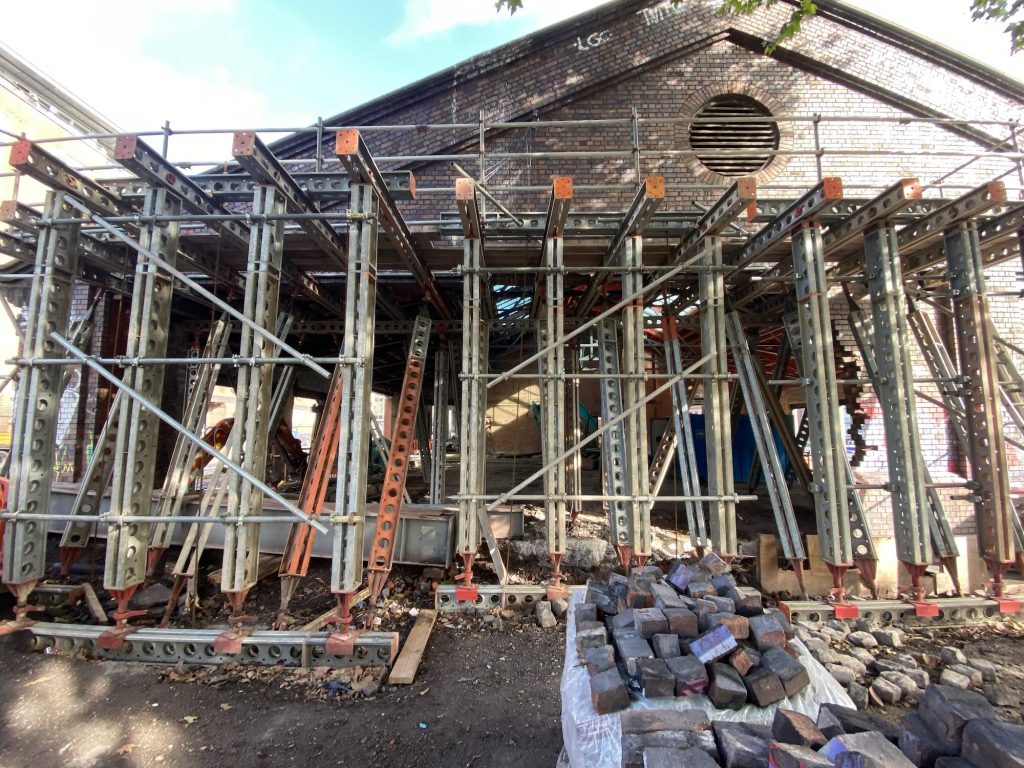
The bread and butter of domestic temporary works. Used every time a wall comes out, a beam goes in, or a chimney breast is removed.
Used where an entire wall or façade has to stay upright while the structure behind it is rebuilt — common for listed buildings and basement work in conservation areas.
The temporary structure that holds wet concrete in place until it cures — and the scaffolding-like falsework underneath that carries the weight.
Holds the sides of trenches and basement digs open while the permanent walls go in — critical in West London’s clay, where deep excavations are routine.
If your property is in:
You’re likely dealing with:
Any of these factors can quietly turn a simple propping job into a more careful one. A local chartered structural engineer knows which assumptions are safe, which need verification, and how to keep Building Control and neighbours onside.
Not all engineers are equal — especially for temporary works on older West London stock.
Yes — any propping, shoring or falsework that supports people, permanent structure or adjacent buildings should have a chartered structural engineer’s calculated design. BS 5975 and CDM 2015 both require it.
Sometimes, for the simplest short-span Acrow under a small lintel. But for anything more — wide openings, chimney breast removal, shoring, façade retention or basement support — a designed temporary works solution is essential.
Typical domestic temporary works design runs 1–3 weeks from instruction to issued drawings and calculations, assuming site access is straightforward and existing-structure information is available.
Almost always, yes. Drawings lie, measurements don’t. We need to see wall thicknesses, floor construction, ceiling heights and any prior alterations before we size props or shores — otherwise the design rests on assumptions that don’t survive first contact with the building.
Yes, for any notifiable works. We design the temporary supports; your contractor writes the method statement describing how they’ll be installed, monitored and removed. Our method statements service coordinates both so nothing falls between the two.
Party walls and unknown load paths. Victorian terraces share party walls that can’t take point loads safely, and older buildings rarely match their drawings. The safest design spreads load properly, verifies more on site, and never props straight into an unknown wall.
Often, yes. If propping, shoring or excavation happens within 3m of a neighbour’s building, or supports a shared wall, Party Wall notices are usually required. Your engineer should flag this at the temporary works design stage.
For older properties, listed buildings or anything involving existing structure — yes, often. Temporary works design is only as good as the information about the building it’s supporting.
WhatsApp us